Hip Biomechanics: Part 6 of 6, The Conclusion (for now)
A Piece of the Functional Puzzle: Hip Rotation As we have already mentioned, stabilization of the hip is complicated in its own right, but when we ask it to participate in balanced single limb …

Hip Biomechanics: Part 6 of 6, The Conclusion (for now)


A Piece of the Functional Puzzle: Hip Rotation

As we have already mentioned, stabilization of the hip is complicated in its own right, but when we ask it to participate in balanced single limb movement and stability in the frontal/coronal, sagittal and axial planes all at once, the delicate balancing act of of these components is sheer genius.

Through our collective clinical experiences it has become apparent over time that vertical and horizontal gravity dependent postural examination can open insight into a deeper functional disturbance in patients.  For example, an externally rotated right lower limb as evidenced by an accentuated external foot flare should initiate the thought process that there is either an anatomically short right limb (external rotation increases leg length), tight right posterior hip capsule, short gluteals or other posterior hip musculature (piriformis, obterators, gemelli), weak internal hip rotators, weak stabilizers of this internal hip rotation, or possibly an over-pronating right foot which shortens the limb and hence the need for the externally rotated and lengthened right limb (ie. failed compensattion).  What we mean by this last component is that there are really two basic types of presentations, those that are compensations to an underlying problem and those that are failed compensations. In consideration of all scenarios, our traditional thinking has directed us to believe we are dealing with a limb posture that has occurred to lengthen the limb in question.  However, perhaps the compensation is deeper in its root cause.  For example, the traditional thinking in alignment restoration of this postural deviation is to stretch the piriformis, glutes and iliopsoas and perform deep soft tissue work such as myofascial release methods, stripping, post-isometric release and mobilization or manipulation to the affected tissues and associated joints to ensure normal function.  These efforts are meant to restore the limbs rotational anomaly and hopefully the cause of the leg length compensation. However, many clinicians will attest to the fact that these methods are frequently unsuccessful or at least limited in their short or long term effectiveness towards complete symptom and postural deficit resolution.  Frequently our patients enter into the cyclical office visits several times a year to address symptoms associated with the root cause.  Thus, we must delve deeper into the source of the problem, perhaps those above methods are focused at resolving the neuroprotective compensation and not the lack of strength or stability of internal hip rotation.  This approach will require the therapist to investigate the open and closed kinetic chain functions of these external and internal hip rotators and look further and more deeply for the source.

In the open kinetic chain (swing phase of gait) the primary and secondary external rotators turn the lower limb outwards in relation to a fixed pelvis established by a sound core; this is late swing phase. This external rotation is, at this point, largely assistive in driving foot supination to gain a rigid foot lever to toe off from.  In the closed kinetic chain scenario, with the foot engaged with the ground, the activation of these same muscles will cause the same movement at the hip-pelvis interface but in this case the pelvis/torso will rotate.  For example, in observance of a closed chain right lower limb, upon activation of the glutes, piriformis and accessory external hip rotators the client’s pelvis and thus torso will rotate to the left (counterclockwise rotation) along the vertical body axis about the fixed right limb.  With this functional thinking we must now embrace the fact that our traditional perspectives of body function assessment in the frontal and sagittal planes must be largely discarded.  It is a rare occurrence that we move in a single plane of motion without any component of rotation.  This being accepted, we must return to our client’s left pelvis rotation and understand that torso rotation must occur in the opposite direction if gait is to be normal with proper arm swing and propulsion.  This rotation can occur from activation of not only component muscles at the hip-pelvis interval but also from the abdominal obliques, thoracic spine and rib cage.  Therefore, one could hypothesize that a client’s external rotation of the right lower limb in stance or gait might not be a primary problem with the piriformis, glutes or accessory muscles rather it could be a compensation for either a one sided over-active or  weak abdominal oblique system/sling/chain or abnormal thoracic rotation, or a combination of both.  Assessment of a patient’s passive and active torso and thoracic/rib rotation might open a window into one of a range-driven deficit or weakness/inhibition. Shoulder mobility assessment is going to be necessary as well because it can and will effect torso/rib cage mobility, arm swing is a huge predictor and indicator in faulty gait assessment and it is one frequently overlooked (type in “arm swing” into our blog SEARCH box and you will be excited to read the research on arm swing in gait). The practitioner must always embrace the thought that the client’s core might not only present as weak but to a higher level that of imbalanced, which is a combination of weakness, stretch weakness, strength, over-activation, inhibition and impaired movement patterns (including breathing).  This imbalance can come from such parameters as pain, handed dominance activities, lower limb dominance issues, occupational demands or others as discussed below.

What we continue to find as our clinical experiences expand is that many deficits in the body are driven by a functional core weakness/imbalance or forces not dampened across a weak core and from impaired gait biomechanics.  In this case, the absence of balanced core abdominal strength and torso rotation renders a weaker or inhibited core rotation/lateral bend on one side and it is this deficit that is often compensated in the pelvis as a tight hip/pelvis soft tissues unilaterally (expressed perhaps as the unilateral externally rotated limb). This will often alter function, strength and mobility in single leg stance during the gait cycle and enable a compensatory cheat into one or several of the cardinal planes of motion. This is of course but just one scenario. Taking the example above, a right externally rotated lower limb with associated tight and/or painful right piriformis muscle, we frequently (but yes, not always) see a loss of rotation range or strength into left torso rotation.  This can be seen on supine rolling patterns looking for upper or lower limb driver deficits. This scenario might be showing little to no progress with therapy but may do so with focused work on supine rolling patterns.  Therapeutically facilitating oblique abdominal strength to improve range and strength into left thoracic/rib cage rotation over time may reflexively reduce the piriformis spasm and rotational deficit in the right lower limb without even applying much direct therapy to this area.  In other words, our experience shows that improving the thoracic rotation into the side of limitation can have some neurologic response of inhibition/relaxation on the tight posterior hip compartment.  We would be remiss if we were to neglect that this oblique abdominal weakness could coincide with a slight anterior pelvic tilt in the sagittal plane on that side (which promotes weakness of the internal hip rotators since the lower abdominals help anchor them).  We would see a slight bellowing of the left abdominal group and a slight increased anterior pelvic tilt on the same side.  This asymmetrical pelvis posture would load the superior aspect of the right piriformis and force it into spasm due to the sustained pelvic obliquity and slight drop in the anterior direction.  This spasm can inhibit the gluteal group and further complicate the problem.  Keep in mind that a weak left oblique abdominal system would facilitate a tendency towards a sway back position, stretch weak left iliopsoas, and the anterior femoral glide syndrome of the hip (not to mention weak internal hip rotators).  As previously touched upon, activities of daily living such as sleep, stance and sit positions, driving style, handedness, respiration,  functional and anatomical leg length differences, unidirectional floor transfers and simply imbalances in the hip rotators can all cause this imbalance and thus piriformis dysfunction.  In summary, the key to the body in the above scenario is in its ability to create and control rotation.  The ribs, thoracic spine, foot and hips are the most important rotators of the body and their relationship is well established.  Even something as simple as respiration mechanics can be dysfunctional as a result of excessive computer use, reading, driving, sedentary lifestyle and sporting history (one sided dominant sports).  For these reasons, most individuals will be unable to rotate effectively and without compensation patterns so the rotational deficits frequently are expressed either upwards into the thoracic spine, ribs and shoulders (one way to see these problems is to look at shoulder posture and arm swing during gait) or they are expressed caudally into the pelvis at the hips. 

We are sure there is more in us on hip biomechanics but for now this 6 part series will have to suffice. We are putting it aside for now and will move back to some other issues on gait and  human movement so we do not get stale.  We hope you enjoyed our 6 part series.

Shawn and Ivo  (not just your average gait analysis doctors)

Yet another IFGEC certification

Here is what Diana Keh has to say

“The Gait Guys have really helped me learn more about foot anatomy and biomechanics and how they relate to fitting customers properly for shoes.  I had followed their blog pos…
Yet another IFGEC certification

Here is what Diana Keh has to say

“The Gait Guys have really helped me learn more about foot anatomy and biomechanics and how they relate to fitting customers properly for shoes.  I had followed their blog posts in the past but it was the course that helped solidify those concepts and put them into practice.”
Check her out at:  www.fitgeeksports.com
 
The Gait Guys. Bringing the world of gait geeks together, one shop at a time.
Hip Biomechanics: Part 5 of 6
Sagittal Plane Functional BiomechanicsThus far we have discussed the hip biomechanics mostly in the frontal plane.  The sagittal plane mechanics are much less complex since the axis of movement is in the frontal plane (…

Hip Biomechanics: Part 5 of 6

Sagittal Plane Functional Biomechanics

Thus far we have discussed the hip biomechanics mostly in the frontal plane.  The sagittal plane mechanics are much less complex since the axis of movement is in the frontal plane (the axis is directed horizontally through the femoral heads and pelvis) and the body weight for the most part rests on this same plane (unlike the frontal plane mechanics where the body weight is a moment arm away from the center of the hip rotation).  One of the main reasons the mechanics are a little less complicated for the most part is due to the fact that even with the pelvic obliquity that occurs during gait cycles of swing and stance, the body weight still remains largely over this trans-femoral head axis. 

In the sagittal plane the prime movers are the abdominas and gluteals (flexion and extension of the hip respectively) with some help from the ilopsoas for hip flexion perpetuation. The calf compartment is also  helpful as is arm swing.  The hip flexor synergistic muscles are the quadriceps and abdominals while the hip extensor synergist is mainly the hamstring group.  This is certainly simplified since transaxial rotation through a vertical oriented axis does occur as a coupled motion and thus we cannot talk about sagittal plane movements, or even frontal plane movements for that matter, without at least considering the effects of movement generation or stabilization by the hip intrinsics (gemelli, oburators, quadratus femoris, piriformis). 

The greatest body function in the sagittal plane is gait and many of the body’s compensations and conditions stem from alterations in hip joint function through this movement negotiation through the sagittal space.  For the therapist, clinician or trainer the greatest problem can be the body’s numerous back-up systems which compensate and share normal or abnormal loading.

The basis of gait evaluation needs to be based from a holistic perspective.  Gait cannot be evaluated without consideration of the entire organism. A minor functional limitation in the first metatarsophalangeal (MTP) joint can significantly impact hip, pelvic and spinal biomechanics.  The best and simplest example of this is the clinical scenario of hallux limitus.  We will entertain the equally devastating functional hallux limitus later on in the chapter but the point to note here is that a minor loss of the last few degrees of the normal MTP joint dorsiflexion (45-60 degrees is necessary, patient specific) can be devastating to sagittal plane motion of the body.  Even a loss of the last 5 degrees of this normal range, although appearing relatively normal on an examination and possibly without symptoms (ie. early stages of progression into a more noticable hallux limitus), can impact normal and efficient toe off.  If toe off is early, even to a small degree, then the stance phase will be abbreviated via early heel rise.  If heel rise is early this creates a functional change in the kinetic chain, both open chain and closed chain.  There are many closed chain changes that will occur. One such change might be toe off propulsion forces being imparted through a more flexed tibiofemoral joint (knee) which will impart both translatory shear forces in the sagittal plane and torsional forces through the joint, both causing potential maceration effects on the menisci.  However, perhaps the easiest functional changes to understand are the changes at the hip.  It is well known on EMG studies that hip flexion is both an active and passive motion during gait.  The active flexion of the hip is generated largely by iliopsoas concentric contraction.  However, this is not the first mechanism to generate hip flexion.  In fact, hip flexion is first generated passively through engagement of the kinetic chain.  The first movement of the swing phase is rotational or torsional activation of the oblique pelvis through core activiation of the abdominal muscle group.  Through activation of the internal and external abdominal obliques and transversus abdominus, in addition to activation of their synergists and cocontration of their antagonistic stabilizers, the obliqued pelvis is rotated.  Better said, the trailing leg’s lagging pelvis is moved forward by contract of the synergistic oblique activation.  This forward movement generates a sagittal momentum and movement of the toe off leg.  Once movement is generated then the iliopsoas activates concentrically to perpetuate hip flexion.  In other words, the ilopsoas is not an initiator of hip flexion, rather, a perpetuator.  When hallux limitus limits the stride length via early generation of heel rise the pelvic obliquity is limited.  As a result, the degree of initial swing phase leg movement is less from the generation of pelvis de-rotation via abdominal activation and more through ill-directed iliopsoas hip flexion.  Thus, as hip flexion still needs to occur, the iliopsoas is called upon to compensate; it now becomes a hip flexion initiator as well as its previous function of hip flexion perpetuator.  This demand is minimal but with repetitive demand thousands of steps per day, the iliopsoas eventually looses its ability to continue these compensations, as does its now over burdened synergists.  The result is either hypertrophy, inhibition, hypertonicity, spasm, shortening, insertional tendonitis, origin tendonitis or a combination thereof but make no mistake, such burden will eventually cause dysfunction within the muscle itself or within its synergists or antagonistic pair.  The scenario may result in either joint dysfunction at the lumbar spine near the muscle’s origin, at the sacroiliac joint over which it crosses, or at the hip joint proper.  The ensuing joint derangement or dysfunction is complex and creates numerous compensation patterns locally and globally since the main function of the muscle is to create hip flexion, external rotation, and abduction in the open kinetic chain and trunk flexion and trunk internal rotation in the closed kinetic chain. In a nutshell, the loss of dorsiflexion of the hallux, even to a minor degree, must be made up somewhere in the sagittal plane.  If it is not immediately made up for at the more proximal joints (1st metatarsal-midfoot joint, talo-navicular, ankle mortise-tibiotalar, or knee) the hip will undoubtedly change its function as described above to compensate, it is well suited to do so.  Keep in mind that such compensations may be better suited at the ankle, knee or hip depending on the degree of hip ante/retrotorsion or tibial internal/external torsion if present but none the less these compensations have consequences to changes in function of muscles either eccentrically, isometrically or concentrically or by recruiting assistance from synergists or antagonistic groups.  Additionally, a person with a very flexible midtarsal joint may stop the more proximal compensations via restoration of the necessary first ray (first toe) complex dorsiflexion at that more immediately proximal joint complex. 

Shawn and Ivo (yup, that is Dr. Allen thinking he is a bad ass in the picture above, clay pigeon shooting and a cubano……. thinks he is Clint Eastwood or something. Regardless, don’t mess with The Gait Guys !).

Shoe Facts: The Outsole (also called the “sole”)
This is the part of the shoe that comes in contact with the ground. It is often made of rubber and provides for traction and some degree of shock absorption. It can be sewn, cemented or in…

Shoe Facts: The Outsole (also called the “sole”)

This is the part of the shoe that comes in contact with the ground. It is often made of rubber and provides for traction and some degree of shock absorption. It can be sewn, cemented or integrated with the midsole.

Remember that the heel strikes the ground at approximately a 16° angle, lateral from the center of the heel.  The force is then transmitted from the sole of the shoe, up the lateral column of the foot and across to the first metatarsal for propulsion (add link see mondays post here for more on progressional forces).  This can be assisted by a “rocker” which is a “drop” put into the front portion of a shoe, to ease walking and assist in toe off (more on this in  another post). 

A flare to the sole of the shoe (usually at the rear, medial or lateral), can be important for stability on uneven surfaces, by providing a bigger “footprint” or surface area contacting the ground (much like Dr Allen’s new Dodge truck).  A lateral flare provides extra stability upon heel strike by preventing too much inversion of the heel, but it speeds up the rate of pronation.  A medial flare would slow pronation (not great for a supinator though, or folks who keep weight on the outside of the foot for extended periods of time). This flare’s placement (whether medial or lateral) will profoundly affect forces at the mid tarsal joint as the foot comes through mid stance. 


The Gait Guys. Making you more “shoeliterate” each day!


Want to know more? Email us at thegaitguys@gmail.com for information about our National Shoe Fit Certification course.


copyright 2012 The Homunculus Group/ The Gait Guys. All rights reserved. DON’T RIP OFF OUR STUFF.

Podcast #15: Brain Size, Gait and Evolution to Bipedalism

Here is the link to the podcast:

http://thegaitguys.libsyn.com/webpage

And it is up on iTunes already.

You don’t want to miss this podcast gang ! Whether you are a runner, walker, trainer, scientist, therapist or just a plain old information junkie, this is a podcast you do not want to miss !

___________________________


4- DISCLAIMER:
We are not your doctors so anything you hear here should not be taken as medical advice. For that you need to visit YOUR doctors and ask them the questions. We have not examined you, we do not know you, we know very little about your medical status. So, do not hold us responsible for taking our advice when we have just told you not to !  Again, we are NOT your doctors !


6- EMAIL FROM A Blog follower: 
abnewman10 asked you:

Both my big toes planterflex. My right toe has Morton’s toe and elevates when standing in neutral. My left toe elevates and twists inward when standing in neutral - I think I have Rothbarts toe. I have tried two orthotics that drop my big toes and it caused a lot of pain up through my pelvis and back. What are the treatments for Morton’s toe and Rothbart’s toe for the big toe joint - would you use a Morton’s toe joint pad and/or full Morton’s extension? Thank you, Andrea

Another IFGEC Certification Granted!
“My name is Eric Johnson.  I’m a runner and triathlete, and manage a running store called Ultramax Sports in Springfield, MO.  I am a self-confessed exercise physiology nerd but don’t have an ad…

Another IFGEC Certification Granted!

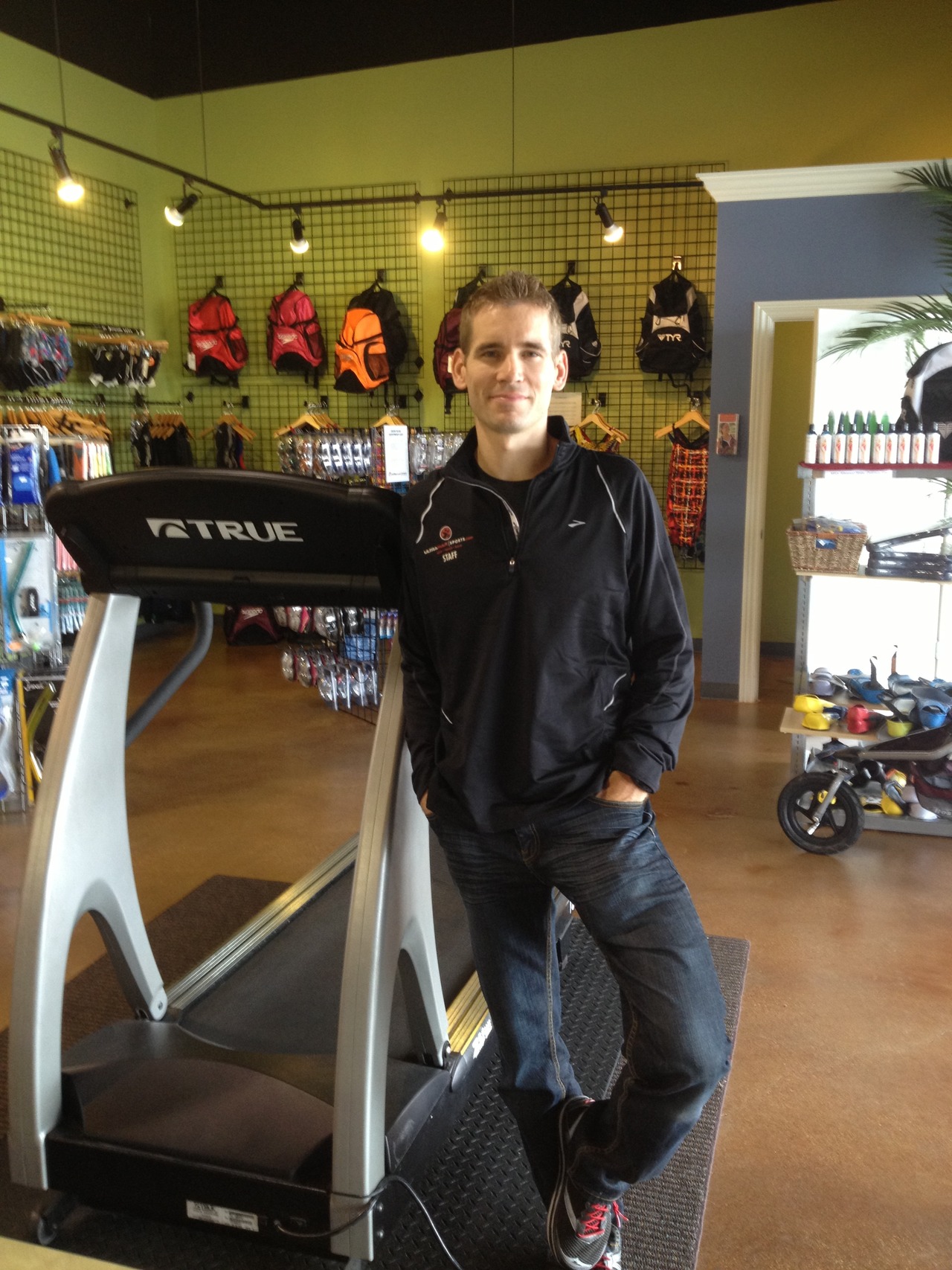
“My name is Eric Johnson.  I’m a runner and triathlete, and manage a running store called Ultramax Sports in Springfield, MO.  I am a self-confessed exercise physiology nerd but don’t have an advanced degree in exercise science.  As a result, I’m always reading and trying to learn more.  My fascination with running, shoes, and injuries also stems from an extended bout of lower leg problems stemming from attempting to run through an injury in the early 2000’s.  I came across the Gait Guys’ tumblr blog one day and was instantly fascinated by the detailed descriptions of human gait abnormalities they wrote about but also how easy it was to apply to myself and my customers.

At our store, we pride ourselves on doing very thorough fittings, including detailed athlete history, foot and leg observations, video gait analysis, and trying on lots of shoes with close customer care.  We’ve been doing this fitting process since we opened in the late 2000’s and have built a very solid following based upon customer care and attention to detail.  We try to avoid the fads and base our process on scientifically valid methods.  Through my explorations over the past couple of years, it became apparent that some of the things we were doing were right and some were wrong. 

I had the opportunity to watch Shawn and Ivo speak at the 2011 IRRA conference and was very excited when they announced the upcoming release of a shoe fitting certification.  It took a bit longer than expected, but it was well worth it.  The three Level I videos were very clear and easy to understand, and it was an easy shift to apply the concepts to our fitting process.  I took and passed the Level I exam today in fact, and am working on the first wave of changes our store will be implementing on our shoe fitting process.  My understanding of the anatomy and physiology of human gait is incredibly better now.  In fact, I was able to apply concepts from the videos to a customer the other day whom I would not have served as completely without that knowledge.  She had been fit at our store in the past, but commented that our level of knowledge really seemed to grow in the interim.  She loved learning about why her feet her and why certain shoes felt better.  She was also very grateful to learn exercises to help her particular condition.

This certification has the potential to greatly impact the running industry in a very positive way.  I wholeheartedly recommend all of you run specialty managers/owners/staff who want to provide a more complete and accurate experience for your customers to pursue this certification.  Customers will be more impressed with your level of knowledge and your returns will reduce.”

Gait Guys. Certified! Get the edge!

tumblr_mcxyteSpsV1qhko2so1_1280.jpg
tumblr_mcxyteSpsV1qhko2so2_1280.jpg

What were they thinking?

You have heard us talk about the normal lines of force as they travel through the foot. In the drawing above you will see several options of force travel through the foot, the one that makes it through the big toe is typically the most normal and advantageous. They begin at the lateral heel, travel up the lateral column of the foot to the head of the 5th metatarsal, go across the transverse metatarsal arch (or more appropriately, transverse metatarsal area) to the head of the 1st metatarsal, and out through the center of the hallux (or big toe). Again, look at the left portion of the diagram on the top.

You have also heard us talk about tread patterns on the bottom of the shoe or outsole. The “lines” or siping should work in concert with the forces as they travel through the foot.

Now look at the diagram on the right. Something is awry here. Do you see it? Why do the treads stop at the tail of the 5th metatarsal (base of the little toe’s metatarsal)? Why does the siping that travels the length of the foot go from the medial (inside) of the heel to the lateral (outside) part of the foot? Depending on where on your foot you strike the ground, this could seriously change the direction of force though the foot.

Look at the bottom of footwear. Look at the lines that the forces will follow. Something that “looks cool” may not actually be so cool for our biomechanics!

The Gait Guys. Stretching your brain each day : )


Drawing courtesy of Tom Michaud.

All material copyright 2012 The Homunculus Group/The Gait Guys. If you want to use our stuff, PLEASE ASK 1ST!

Dr Ivo would like to thank Everyone who participated in our “Foot Fest” Tuesday evening at the office. Good Info, Good Food (provided by “Toosie’s Gluten Free”) and Good times. We gave away some great stuff and people …
Dr Ivo would like to thank Everyone who participated in our “Foot Fest” Tuesday evening at the office. Good Info, Good Food (provided by “Toosie’s Gluten Free”) and Good times. We gave away some great stuff and people went away informed.

Here is a follow up article you may enjoy!

http://www.runnersworld.com/article/0,7120,s6-238-267-268-8210-0,00.html
Hip Biomechanics: Part 4 of 6
This diagram (Figure 4) also shows a balanced equation; HAM x D1 = D2 x BW.  (where HAM=hip abductor/g.medius, D1 and D1 are lever arms, BW= body weight). This is not exactly a desirable scenario or strategy to obtain w…

Hip Biomechanics: Part 4 of 6

This diagram (Figure 4) also shows a balanced equation; HAM x D1 = D2 x BW.  (where HAM=hip abductor/g.medius, D1 and D1 are lever arms, BW= body weight). This is not exactly a desirable scenario or strategy to obtain when it comes to joint compression mechanics however it is close to representing what is accurate in the human hip.  Since the gluteus medius muscle is the primary joint compressor in the frontal plane (it applies two thirds of the compressive forces across the joint) we would ideally never want such a large HAM force.  Typically the internal to external moment arm ration is 2:1 thus this model would require a HAM force twice the body weight to maintain a balanced system.  None the less, we would want to offset these forces somehow.  The only way to offset the large HAM would be to move the pivot point closer to the BW thereby increasing the D1 (increase D1 and you can reduce HAM and thus joint compression load).  In a physical person the pivot point, the joint axis of movement, is fixed so there is no real strategy to improve the situation without surgery.  These patients are unlucky and have no strategies to improve their high compression forces unless they loose weight; due to the fact of the 2:1 ratio, for every pound of body weight loss there is a 2 pound force decrease in the HAM.  Obesity is going to wreak havoc on our populations hips.

As mentioned previously, the model presented is very much incomplete.  Muscular forces surround the joint, movement occurs in every cardinal plane and there is acceleration of body segments which requires even greater muscular contraction isometrically, concentrically and eccentrically.  These factors all considered, it has been calculated that the total hip force crossing the joint can reach 3 times the body weight during walking.   This force is welcomed for maintaining joint stability but it can be an unwelcome force in a degenerative arthritic joint where the cartilage is less pliable and flexible.  The loading forces in an arthritic joint rhythmically pass into the acetabulum and femoral head as a result of the compromised cartilage necessitating increased bone mass and sclerosis within them.  This compromised arthritic joint will have some minor laxity due to the loss of the cartilage bulk and thinning of the acetabular labrum.  Thus the joint will have a slight increase in translatory/accessory movement and require greater muscular contraction to minimize/stabilize these movements.  These increased forces will be unwelcomed as they will generate more pain.  Additionally, the increased movements and degenerative debris within the joint will cause irritation and inflammation of the joint capsule and synovial lining causing further pain.  This entire scenario will cause the patient to investigate conscious and subconscious gait strategies to reduce the compression across the joint, in other words, they will essentially seek gait strategies that will reduce HAM (gluteus medius contraction) and increase the D1 internal moment arm.  These strategies will reduce the perpendicular joint compression forces that likely will be causing pain but if performed well they will be devastating to the normal frontal plane equilibrium since the gluteus medius muscle will be essentially shut down and inhibited.  Thus, the patient’s gait strategy will give us the compensated Trendelenburg gait pattern.  The uncompensated Trendelenburg gait will show a dropping of the contralateral hemipelvis on the swing side during gait, this is the pathologic gait pattern we see when the patient has not implemented strategies to reduce their pain but it is more likely seen when the patient is not yet at the painful stage in which they need to implore strategies to avoid the movement.  Comparatively, compensated Trendelenburg gait pattern will display a lifting of the contralateral hemipelvis.  This strategy is not implemented by activation of the gluteus medius on the side in question, rather it is a compensation move performed by shifting the patient’s body weight over the pathologic hip thus causing the hip that is dropping to be passively raised into a more normal range in the frontal plane.  This passive frontal plane move by the patient over the painful hip is at first difficult to embrace logically as one does not expect to want to load their body weight further over top of the painful hip.  However, upon investigation of the mathematical equation one will see that the shift of body weight (BW) over the affected hip will significantly reduce the D2 external moment arm, significantly increase the D1 internal moment arm and thus deliver us the desirable significant reduction in the HAM gluteus medius compressive contraction across the painful hip.  Thus, the pathologic compensation gait pattern in the frontal plane will markedly reduce the patient’s hip pain.  From a kinetic chain perspective however, there is always a price to pay.  This implemented strategy of ipsilateral trunk lateral flexion is performed by utilization of the thoracolumbar paraspinals and quadratus lumborum on the painful hip side. The resulting abnormal muscular and joint strategies now imparted on the lumbar spine and pelvis interface frequently begins a cascade of muscular and joint pain in the low back and abnormal loading of the lumbar discs.  The strategy also begins an unwelcome increased loading of the non-painful hip as the patient is loading the hip greater than normal due to the height from which the hip and pelvis drop from the compensated Trendelenburg position.  In other words, by protecting the painful arthritic hip from increased loads we sacrifice the healthy hip for a period of years until the forced finally amount to enough damage that pain begins here as well.  Fortunately, we have the ability to mediate some of these dramatic movements and forces by using logic and a cane.  By placing a walking cane in the hand opposite to the painful hip and by asking the patient to contact the cane with the ground when they initiate contact with the painful limb we can offset some of the excessive compensations and forces.  When the cane contacts the ground the patient is to apply a mild to moderate downward force through the cane via arm contraction.  This downward force will afford us a resultant upward ground reactive force through the cane delivering us a lifting effect on the dropped hemipelvis side (dipping hip side/non-painful side).  This strategy will allow us a more passive shifting of the body weight (BW) over the painful hip side without having to lift or pull the body weight (BW) over the painful hip with the hip abductor muscles (HAM).  These passive forces (which can be more than  half of those normally needed to be generated by the HAM) will help to markedly reduce the muscular forces needed by the spinal and quadratus muscles while also rendering the desired marked reduction in HAM compressive forces across the painful joint.  It is interesting to note that the further the cane is placed from the body, the longer its moment arm and thus the less downward force necessary by the patient’s arm.  It is quite possible, that if used correctly, a cane can almost completely offset the required contralateral HAM force.  Another passive strategy would be to carry objects (purses, books, grocery bags, etc) on the affected hip side.  This action will also balance the teeter-totter  in favor and thus reduce the muscular forced necessary to perform the same task.  It must be noted however that increasing any body load is undesirable and should be avoided not so much because of issues pertaining to the painful degenerative hip but because of the increased load on the healthier hip.

Shawn and Ivo, The Gait Guys

All materials are copywrited. Don’t rip our stuff off ! Just ask nicely if you can link or reference. Play nice, play fair.

Podcast #14: Forefoot Strike & Evolution

Podcast #14

Here is the live link:   http://thegaitguys.libsyn.com/webpage

iTunes will load it likely by the afternoon. Find it on iTunes through this link:

__________________________________________

Payloadz link for our DVD’s and efile downloads: http://store.payloadz.com/results/results.asp?m=80204

1- National Shoe Fit Program and Certification

2- email from a reader
from: Mikkel
I am currently treating a 15-year-old boy who as a child suffered from left sided equinovarus deformity and was operated. His left gastoc/soleus complex is underdeveloped, and he has impaired ankle rocker due to bony limitations anteriorly in the mortise joint causing anterior ankle pain when running and jumping. He has a distinct limp on the left leg due to decreased ROM and pain. He has an inverted calcaneus and forefoot valgus deformity on both feet (left more than right). He pronates heavily through the mid and forefoot to progress forward. Treatment thus far has had limited effect on the pain symptoms. I’ve manually mobilized the tibiotalar joint with posterior glides of the talus + given him exercises to strengthen the anterior compartment.
Would you consider orthotics? I’m thinking stability shoe with medial arch support maybe with a forefoot drop. Normally I would prefer stability and strength training and foot tripod exercises, but due to bone structure I have started to think, this isn’t enough. The pain limits him from running and playing soccer.
How would acupuncture fit into a treatment program in this case? which points could you recommend?
Any additional info and inspiration is welcomed.
kind regards - Mikkel

 http://en.wikipedia.org/wiki/Club_foot

2- Know your foot strike
http://sweatscience.runnersworld.com/2012/10/do-you-know-your-footstrike/

3- Caffeine: A PED ?

http://news.menshealth.com/chew-gum-before-races/2012/04/12/

Chew on this: Caffeinated gum can improve your athletic performance—if you start chewing it at the right moment, finds a new study from Kent State University.

 http://www.energyfiend.com/the-caffeine-database

4- DISCLAIMER:We are not your doctors so anything you hear here should not be taken as medical advice. For that you need to visit YOUR doctors and ask them the questions. We have not examined you, we do not know you, we know very little about your medical status. So, do not hold us responsible for taking our advice when we have just told you not to !  Again, we are NOT your doctors !

5: more lectures available  on www.onlineCE.com   Go there and look up our lectures

6- EMAIL FROM A Blog follower: 
Why do some muscles go weak and others not ?
First lets talk about tightness vs shortness. We are getting exhausted from always hearing about tight piriformis, psoas hip flexors and IT Bands.
Now, lets define 2 types of weakness…….
a- physiologic /  disuse
b- neurlogic inhibition

7- Our dvd’s and efile downloads
Are all on payloadz. Link is in the show notes.
Link: http://store.payloadz.com/results/results.asp?m=80204

8 - Creatine:
 http://www.foxnews.com/health/2012/10/11/creatine-myths-and-facts/

9- The one perfect test for a runner ?
 http://news.menshealth.com/find-your-perfect-running-pace/2012/10/14/
The Talk Test
Researchers for the study put 18 well trained cyclists through two identical fitness tests. In one test they measured the above thresholds with traditional medical equipment. In the second test they asked cyclists to say a paragraph while exercising. What they found was that the cyclists’ “out-of-breathness” matched the thresholds. “From our standpoint, the TT is very useful and almost ‘idiot-proof,’” Foster says.

Podcast #13: Caffeine, Nicotine & Lance

here is the link for podcast 13

http://thegaitguys.libsyn.com/webpage

______________________________

1- Malcolm gladwells piece on drug doping (PEDs) in sports:

“Gladwell argued that we should think about cycling the same way we think about auto racing — where teams should be rewarded for using science and bending the rules to their breaking point to succeed.
"When you look at what Lance is alleged to have done. Basically he was better than everyone else at using PEDs,” Gladwell said. “He was the guy who sat down and was rigorous and focused and thoughtful and intelligent and cutting edge in how to use them, and apply them and make himself better. Like, I don’t know, so is that a bad thing?”

Read more: http://www.businessinsider.com/malcolm-gladwell-lance-armstrong-2012-10#ixzz29QBKJpAJ

2- Caffeine: A PED ?
Mens health online magazine, also found in our Sunday edition Oct 14th, 2012 newspaper:

http://news.menshealth.com/chew-gum-before-races/2012/04/12/

Chew on this: Caffeinated gum can improve your athletic performance—if you start chewing it at the right moment, finds a new study from Kent State University.

NICOTINE: http://www.t-nation.com/free_online_article/most_recent/50_hits_of_nicotine
Nicotine has been used in energy drinks in Japan for years.
stimulates the release of acetylcholine, providing a sense of increased energy. Arnold used to do commercials for them.
Nicotine can improve reaction time.
Nicotine can be addictive, much like caffeine. But addiction to nicotine gum, lozenges, or patches is rare, if not unheard of.
MAYO clinic: http://www.mayoclinic.org/medical-edge-newspaper-2009/apr-24b.html

3- DISCLAIMER:We are not your doctors so anything you hear here should not be taken as medical advice. For that you need to visit YOUR doctors and ask them the questions. We have not examined you, we do not know you, we know very little about your medical status. So, do not hold us responsible for taking our advice when we have just told you not to !  Again, we are NOT your doctors !

4: Maryland Guy Running a marathon in flip flops:

“Some of the rules: It can’t be a heal strap. There can’t be any other means to hold the flip flop on your shoe besides just the normal thing between your toes,” Levasseur said. “I don’t know what happens if I get a blowout.”

Read more: http://www.wbaltv.com/news/sports/Man-to-run-Baltimore-marathon-in-flip-flops/-/9379464/16917220/-/remeou/-/index.html#ixzz29QDIyW4d

5-Managing Ankle Sprains:
http://www.running-physio.com/anklesprain/

6- HIIT
 http://www.the15minutes.info/2012/10/12/what-is-hiit-and-what-can-it-do-for-you/

http://sportsmedicine.about.com/od/anatomyandphysiology/a/Deconditioning.htm
Studies have shown that you can maintain your fitness level even if you need to change or cut back on you exercise for several months. In order to do so, you need to exercise at about 70 percent of your VO2 max at least once per week.

7- EMAIL FROM A Blog follower:

middleagedathlete asked you:
I searched the site and didn’t see anything on bow-leggedness (if that’s a word) and it’s impact on gait. I have mild to moderate bow legs and never even knew it until I started running and it was pointed out to me by a PT I was seeing for knee pain. Is there an optimal (or at a minimum least bad) strategy for running with bow legs? I am 6'0" tall and have a gap of about 2" between my knees when standing with my ankles together and my legs straight. I am curious to hear your thoughts.

8- from the newspaper:
from Barefoot Running University.com
Article: Running up Hill

 http://barefootrunninguniversity.com/2012/10/12/uphill-running-technique/
9- Blog post we liked recently: October 5th, Gait Running and Sound. Are you listening to your body ?
 
 
10- Random topic: Wednesday october 10th Peter larson who runs Runblogger did a review of the following article:

Minimalist Running Results in Fewer Injuries?: Survey Suggests that Traditionally Shod Runners are 3.41 Times More Likely to Get Hurt

we have not gotten through the research article yet but we will, and we will try to address out thoughts on it and pete’s in the next 1-2 podcasts.  We want to make sure our thoughts are heard as well.  We bet Pete did a phenomenal job but we like to see things for ourselves, just like pete does. He is a stickler to details like we are, which is why we like alot of his work.  So, stay tuned !

11- Our dvd’s and efile downloads
Are all on payloadz. Link is in the show notes.
Link: http://store.payloadz.com/results/results.asp?m=80204


Food Alert ! Gluten and your Thyroid. What you don't know, but should.

Every now and then we come across something that we think the whole world should know about, kind of like GMO foods.  Gluten is another. Today, more than 1 in 133 Americans suffer from gluten related health problems while an even higher percentage of the population goes undiagnosed with an emerging condition called ‘gluten sensitivity.’ From a website doctorauer.com we discovered, but have not yet fact checked this following historical mention:

“In 1843, a physician named Stanislas Tanchou spoke at the Paris Medical Society Conference. He claimed that he could predict the cancer rates in major European cities over the next 50 years. He based his predictions on the percentage of grains being consumed in each major city. What is astonishing is that, over time, his predictions turned out to be correct. In the cities that had the highest grain consumption, cancer rates were the highest. This is in stark contrast to the fact that in populations who did not consume grains, cancer did not exist."  - article link

Here at The Gait Guys, being doctors who treat athletes and non-athletes, we have written about gluten in previous blog posts on "Gluten Ataxia” (Link)  and Running yourself into Hormone Trouble (link) because we felt it was important to spread the wisdom. We even recently talked about gluten and how it can damage your thyroid profile and gut via one of the gluten subfractions called gliadin on podcast #12 (link).

These dialogues seemed to spur one of our brilliant and engaged readers and listeners.  Jim sent us a series of emails which you will find below.  We obtained his permission to reproduce the emails (thx Jim !). We will also welcome him to chime in further on Facebook when this post cross-links if he has further input.

We are building a wonderful and brilliant readership and fast growing podcast following. We have smart folks joining the brethren here at The Gait Guys ! And we are blessed to have Jim, and celebrate his homework and knowledge here. 

Everyone should read this, especially if you have tested gluten insensitive but still have gut issues or immune issues. You may have your eyes opened ! 

PS * at the very bottom of this blog post you will find a link to a wonderful video youtube lecture by Dr Osborne. If you watch the first 4 minutes you will learn that corn, millet, oats, rice, rye, sorgum and barley all have their own types of gluten in them.  You will clearly understand why a sensitive person MIGHT get away with rice but not wheat. Hence why this is a very difficult problem for the average consumer. 

Thanks Jim !

_______________________________

 Greetings Gait Guys!

   I met Dr. Allen at the May NSCA conference at CSU. I remember him mentioning endurance athletes being prone to hypothyroidism. I’ve been researching hypothyroid issues since 2007, so of course that piqued my interest. Recently I came across the book “Mastering Leptin” by Byron Richards, CCN. I was familiar with Mr. Richards expertise in thyroid issues from some You Tube videos of his, but I wasn’t prepared for the paradigm changing information in this book. As it turns out, leptin is the master controller of our metabolism.
   Leptin is produced in white adipose tissue, and is supposed to signal satiety when one has had enough to eat. If body fat gets too low for too long with not enough leptin getting to the brain, the brain will signal the endocrine system to go into a starvation/hibernation metabolic reduction as it thinks one is starving, and is trying to save energy until food is found. On the other hand, if there is too much leptin from too much fat for too long, the brain goes into leptin resistance, and the end results are the same, as the brain isn’t getting enough leptin and thinks one is starving (this is a major cause of obesity, besides of our toxic "food" supply, and explains why most calorie restriction diets ultimately fail).
   So, it may well be that endurance athletes may actually just need to put on a couple of pounds of fat to get leptin back up to normal. 
   I cannot recommend strongly enough getting a copy of this book and getting the full story. There’s also a trick involving calcium to re-activate the liver’s conversion of T-4 to T-3, thus re-activating proper thyroid metabolism. I know it works, as it’s worked for me. I had no idea such a thing was possible.
 
I forgot to emphasize that the thyroid is the first endocrine gland to be targeted along with the adrenals. Mr. Richards also emphasizes that there is what he calls the leptin/insulin/adrenal resistance triad. Any problem with one will eventually result in problems with the others. Seeing as this book was first published in 2002, I can’t believe that this hasn’t caught on. It was updated in 2005 (or 6) and again in 2009 (I personally prefer the 2nd edition).

In Nora Gedgadaus’ book “Primal Body, Primal Mind”, she explains that there are actually 12 subfractions of the gliadin protein (gliadin is a biproduct of gluten metabolism). According to her, at least at the time she wrote the book (2012 or 2011) there was only one lab in existence that could test for all 12 subfractions: Cyrex Labs. Most of the other labs only test for the “alpha” subfraction. This is why there are so many false negatives. But the best way is just to go by how one reacts individually to it. For some reason, science doesn’t trump nature as some would have us believe…

Keep up the pursuit of excellence.
 
A Steve Martin Reference:  “Oh no! I’ve got happy feet!”
 
Good Gaiting To You! - Jim C

* Doctorauer’s article concludes with (and many other experts in the field agree ) the following:

“Grains are truly humanity’s double edged sword. They enabled us to leave behind our hunter gatherer lifestyle and created the foundation for the modern societies as we know them today. On the other hand, there is growing evidence that they are one of the major culprits for our health problems.

We must remember that evolutionarily speaking, we have been around for almost two million years, but we have only been eating grains for a few thousand. As such, our bodies have not had the time to adapt to this “new” food in our diet. Furthermore, modern farming, harvesting, and processing methods have stripped grains of their nutritional integrity, decreasing their digestibility, and making them highly toxic and inflammatory food to our bodies. With no doubt, today’s grains are proving to be one of the major underlying contributors to the development of degenerative diseases as we known them today.”

Byron Richards websites are http://www.wellnessresources.com/ and http://www.byronrichards.com/ .

Dr. Osborne’s video youtube lecture:    http://youtu.be/cv5RwxYW8yA