tumblr_lznqh0u6g31qhko2so1_r1_400.jpg
tumblr_lznqh0u6g31qhko2so5_r1_400.jpg
tumblr_lznqh0u6g31qhko2so6_r1_400.jpg
tumblr_lznqh0u6g31qhko2so7_r1_400.jpg

A Case for “Reverse Engineering”

You have often heard us say: “think of muscle function from a closed kinetic chain perspective”. In other words, the muscle(in the case of gait) working from the foot (or ground) up. Here is a study exemplifying this with the tibialis anterior and peroneus longus.

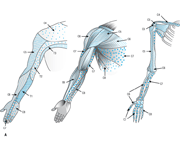
We remember the tibialis anterior is usually the most prominent muscle on the anterior leg (see 1st 2 pictures above). It has two origins, the lateral tibial condyle and the upper lateral surface of the tibia; it inserts on the medial surface of the 1st (medial) cuneiform and proximal part of base of the first metatarsal of the foot. It is a dorsiflexor and inverter of the foot in open chain (ie before and at heel strike/initial contact), and a dorsi flexor and inverter of the foot (or it brings the tibia medially and everts the foot relative to the tibia) from loading response to midstance. It also helps to maintain the medial longitudinal arch up to this point, and assist in decelerating pronation (along with its antagonist to dorsiflexion, the tibialis posterior). It takes a break at midstance and then contracts again at terminal stance (to counter act its antagonist, the peroneus longus). When running, it remains active through midstance to help pull the leg forward over the foot.

The authors have this to say: “Tibialis anterior restrained rearfoot plantarflexion from heel contact to 10% stance, and eversion between 10% stance and footflat.”

No surprises here.

Now the peroneus longus: “Activity in peroneus longus was consistent with its role in causing eversion after heel contact, then as a stabiliser of the forefoot after heel rise. ”

The peroneus (or fibularis) longus arises from the head and upper two-thirds of the lateral surface of the fibula, from the deep surface of the fascia, and from the intermuscular septa between it and the muscles on the front and back of the leg; occasionally also by a few fibers from the lateral condyle of the tibia.  You can see from it attachments that it can influence the entire upper lateral leg.

It’s tendon runs down the fibular shaft, wraps around the lateral malleolus, travels obliquely under the foot, crossing the lateral cubiod (which it everts after midstance to help with supination) crosses the sole of the foot obliquely, and inserts into the lateral side of the base of the first metatarsal and lateral aspect of the 1st cunieform.  

It acts from just prior to heel strike to limit excessive rearfoot inversion, through midstance to decelerate subtalar pronation and assists in stabilization of the midfoot articulations, and into terminal stance and pre swing to lock the lateral column of the foot for toe off and plantar flex the 1st ray (creating a good foot tripod), allowing dorsal posterior shift of the 1st metatarsal-phalangeal joint axis (necessary for dorsiflexion of the hallux (big toe)).

The peroneus brevis arises from the lower two-thirds of the lateral surface of the shaft of the fibua and from the intermuscular septa separating it from the adjacent muscles on the front and back of the leg. Again. lots of influence here.

It travels behind the lateral malleolus (and in front of the peroneus longus) and inserts into the tuberosity at the base of the fifth metatarsal.

It acts in a similar timeframe as the longus, copressing the tarsals to provide midfoot stabilization, and a significant eversion moment of the foot (helping to push you on to the base of the 1st metatarsal).

You can see how the peroneii could work together also to produce a small plantar flexion moment of the ankle and lateral movement of the lower leg. Because of their route around the lateral malleolus, they also can internally rotate the tibia (from a closed chain perspective; remember the tibia SHOULD be extenally rotation at this this point) so it can act to dampen or attenuate supination. This is also supported by the study:

“Activity in peroneus brevis suggested a role in restraining lateral rotation of the leg over the foot, late in stance.”

We are definitely the Uber Gait Nerds of the internet. We are bending your mind around the foot (rather than the foot around your mind).

Ivo and Shawn

Abstract

This study examined stance phase foot kinematics, kinetics and electromyographic (EMG) activity of extrinsic muscles of 18 healthy males. Three-dimensional kinematic and kinetic data were obtained via video analysis of surface markers and a force plate. Ankle joint moments are described about orthogonal axes in a segmental coordinate system. Kinematic data comprise rearfoot and forefoot motion, described about axes of a joint coordinate system, and medial longitudinal arch height. Surface EMG was obtained for tibialis anterior, soleus, gastocnemius medialis and lateralis, peroneus longus and peroneus brevis and extensor digitorum longus. It was concluded that the demands on the controlling muscles are greatest prior to foot flat and after heel rise. Tibialis anterior restrained rearfoot plantarflexion from heel contact to 10% stance, and eversion between 10% stance and footflat. Activity in peroneus longus was consistent with its role in causing eversion after heel contact, then as a stabiliser of the forefoot after heel rise. Activity in peroneus brevis suggested a role in restraining lateral rotation of the leg over the foot, late in stance.

Foot Ankle Int. 2001 Jan;22(1):31-41.

Extrinsic muscle activity, foot motion and ankle joint moments during the stance phase of walking.

School of Physiotherapy, Faculty of Health Sciences, Lidcombe, NSW, Australia. a.hunt@cchs.usyd.edu.au

Erratum in

  • Foot Ankle Int 2001 Jul;22(7):543.
tumblr_lzmm1cj9x51qhko2so1_1280.jpg
tumblr_lzmm1cj9x51qhko2so2_500.jpg
tumblr_lzmm1cj9x51qhko2so3_1280.jpg

A Scientific Look at High Heels

http://well.blogs.nytimes.com/2012/01/25/scientists-look-at-the-dangers-of-high-heels/

PROCEED WITH CAUTION! INFO DENSE POST AHEAD!

Can you think of a better way to start the week than with a discussion of high heels? We all like high heels… Well, at least guys do (and we know quite a few women who do as well…some of you may be reading this post). NO, WE DO NOT LIKE TO WEAR THEM, but we can admire the way they make the calves look so great and the increased lumbar lordosis and accentuation of the greatest gait muscles ever created!

Were they based off “chopines” from the 15th century; an elevated shoe (7-30 inches high!) which kept the peoples feet literally “out of the muck” (they didn’t have modern plumbing back then) or are they older? Or was the heel invented out of necessity to keep horse riders literally “in the saddle” ? Chinese and Turkish history says maybe they were to keep women (particularly concubines) from escaping. For the intents of discussion, we will stick with this last premise, as it fits nicely with the findings of this article (based on the study published here)

Remember the neuromechanics posts on muscle spindles or golgi tendon organs (GTO’s) ? If not, click the links and check them out; suffice it to say that the take home message is: Spindles respond to length and GTO’s respond to tension.

We also remember that GTO;’s modulate the muscles function that they come from. In other words, they literally “turn off” the muscle they come from (it is a disynaptic, post synaptic pathway for you neuro geeks out there). In light of that, lets look at some quotes form the article:

“the scientists found that heel wearers moved with shorter, more forceful strides than the control group, their feet perpetually in a flexed, toes-pointed position. This movement pattern continued even when the women kicked off their heels and walked barefoot. ”

No surprises here. Go up on your toes and take a few strides (more difficult for guys, since the biggest heel we may have is about 12mm in our running shoes). Which muscles are engaging? See how difficult it is to take a full stride? Try to engage your glutes. Not so easy, eh? Now put your foot flat on the floor, extend your toes and NOW engage your glutes. Easier? Presyanptic loading of the motor neuron pool pays big dividends!

They go on to say: “As a result, the fibers in their calf muscles had shortened and they put much greater mechanical strain on their calf muscles than the control group did.”

Hmmm… shortened muscles put under greater tension. Sounds like a job for the golgi’s, and what do they do? Inhibit the muscle from contracting. No wonder is was harder.

“In the control group, the women who rarely wore heels, walking primarily involved stretching and stressing their tendons, especially the Achilles tendon. But in the heel wearers, the walking mostly engaged their muscles.”

Wow, here is evidence They changed their motor programming!  Did you ever think that high heels could change the way our brain works? Maybe it’s a secret plot to take over the world….or maybe not…

The Gait Guys…Lovers of high heels as long as you don’t walk in them….

Athlete with Plantar Fascitis

Gentlemen,
 
I have enjoyed your blog tremendously.  My inner mechanics geek motivated me to read all the blog posts, and go through the Youtube videos as well.  Fascinating stuff.
 
My reason for writing, however is more desperate.
 
I have an athlete with a problem, and hope you might provide some guidance.  She is experiencing what has been diagnosed as plantar fasciitis, with her pain on the medial side of her calcaneus - roughly 2 inches forward of her achilles, and about a half inch up.  MRI was negative for a calcaneal fracture.   She’s taken several months off, and had the site injected, but any return to running brings her pain back.  It’s her mechanics that might catch your interest;  she has what a doctor once referred to as ‘an Equinus Deformity", essentially running completely on her forefoot.  She had heel contact when walking, but is completely on the balls of her feet when racing or training.  Her injury history to this point has been minimal, with only a minor adductor issue for a day or two in her background.  She has been told her options are injection (tried, helps for only a short time) or surgery.  Humbly, is there anything we can do to help her overcome this?  I am convinced there is an underlying mechanical issue, but her somewhat nontraditional running style leaves me with few ideas.  Any suggestions would be worth their weight in gold.  
 
 
Sincerely,
  
Girls XC/track coach
 
Dear Track Coach
Thank you for the Kudos and we are glad you have an “inner mechanics” geek as well .
We are sorry to hear about your athletes recalcitrant problem. It was astute observation on your part regarding her gait. Given the history you have provided, what has already been done, and the description of what you see, please understand that our opinion is limited, without the opportunity to examine her (which we would be glad to do; we have offices in the Chicago, IL suburbs and West of Denver, CO). Video would be helpful in the future as well, as we are not sure she has a true talipes equino varus foot or it is merely describing the attitude of the foot while running.
It sounds like she may have a rigid foot and a forefoot varus deformity. This would parlay with the “equinis” description.
A forefoot varus is when the forefoot to rearfoot relationship is such that the forefoot is inverted with respect to the rearfoot. This causes increased torque on the plantar fascia, as the forefoot lands on the outside of the foot and the medial side of the foot immediately descends: this must be controlled some how: either through flexion (downward motion) of the 1st metatarsal and cunieform (ie 1st Ray complex) provided adequate range of motion is available; the other scenario is that there IS NOT adequate range of motion of the 1st ray available and the knee collapses medially to bring the 1st ray down to the ground. A third possibility (most likely) is that it is a combination of the two.
The fix lies in the etiology: follow the mantra: skill, endurance, strength. Insuring the foot has adequate range of motion and is able to control it (skill), the appropriate endurance of the muscles to carry out the job (endurance) and the foot intrinsics have the cross sectional area needed to do the job (strength).
1. Does the athlete have a adequate foot tripod and are they able to keep all 3 legs of the tripod on the ground with the knee comfortably over the 2nd metatarsal? see a video here
2. does the athlete have enough muscular control of the lower extremity to ensure proper mechanics (foot intrinsics, knee motion, hip motion) ?
3. Is their running gait appropriate for their anatomy and any physical limitations? we have numerous posts covering many different gait scenarios on the blog, as well as on our youtube channel.
Again, without an exam, pictures or video, the exact diagnosis and fix is difficult. Thanks for the opportunity to respond.
The Gait Guys

News about Our blog.

Are you following us on our FACEBOOK page ?

every day we try to add extra stuff that will broaden the info, for example, today we added some extra info onto Facebook regarding muscular infarts such as what House has. 

If you are not a daily follower of our Facebook page you are missing out on a little extra info. 

Just sayin ……

here is the link……. go ahead…….. click the LIKE button…… WE DARE YA !

http://www.facebook.com/pages/The-Gait-Guys/169366033103080

House MD. :  Is he using his cane on the correct side ?

This is a great video clip (when you click on the youtube link it  might not work. Try clicking here ……go ahead and click that link to watch and then come back. Note to listeners…. there is controversy over the lyrics, there always has been and always will be …..but they are listed below at the end of the post.)

When can you ever go wrong with AC/DC ? Combine that with Hugh Laurie from HOUSE MD and you have a great mix.

So, watching this video, why is he using his cane incorrectly?  We all know that House’s has a problem with the right hip and leg.  “The Rules” state that with a hip problem the cane should always be used on the opposite side to change the D2 lever arm (Click here for a great lesson on this) with a nice follow up here (click). After watching these 2 Gait Guys videos you will clearly understand (perhaps to a better level than most of your therapists and doctors who gave you the cane) why it is used on the opposite side.

So, why in the world is the brilliant Dr. House using it on the same side ?  We have received this question more than once.  And the answer is quite simple.  His problem is extracapsular. In the pilot episode of House MD it was explained that he suffered a vascular infarct to the quadriceps muscle.  Like bone infarcts, muscular infarcts can be painful. If he contracts the quadriceps when loading the leg there will be pain.  Just like if the infarct were osseous,  the loading of the cortical bone and stress on the trabecular infrastructure in that case, axial loading of the limb (muscular or osseous) will drive pain. So, to lessen the issue he uses the cane on the same side to literally share his body mass load over the length of the cane.  He is essentially attempting to use the cane as his weight bearing limb.  The cane use on the opposite side is best used when you are attempting to unload the muscular compressive forces across the hip (acetabulofemoral) joint.  Contraction of the gluteus medius generates the greatest joint compressive loading of all of the hip muscles because of its orientation during gait. Thus, utilizing the cane on the opposite side acts as a hydraulic lift necessitating a shift in body mass closer to the joint and reducing the compressive demands on the gluteus medius muscle. 

* Rule breaker: sure, you can still use the cane on the same side to reduce the gluteus medius forces, it is just a bit more awkward.  But it can be done.  Think about and elderly folk who had a weaker opposite arm, they would feel more comfortable using House’s strategy. The rules are not hard pressed. 

So, House is using the cane correctly for his condition. 

Rules are meant to be broken.  Look at our leaders (all parties) in Washington, they do it everyday ! And when you are as smart as House you know when to break the rules. 

Thanks for the reminder AC/DC ……lyrics

“Living easy, living free

Season ticket on a one-way ride

Hey Momma, look at me

I’m on my way to the promised land.

Asking nothing, leave me be

Taking everything in my stride

Dont need reason, dont need rhyme

Aint nothing I’d rather do”

Shawn and Ivo……….. or maybe it is Beavis & Butthead ?

(uh, that’s cool dude !  huhhh huhhhhh …… Those Gait Guys Rule…… !!!! )

The Truth about treadmills. Our Triathlete magazine article finds its way to the TRi website.

Regarding our treadmill article in Triathlete magazine.
Most things in this world have a place, a function, an advantage and a disadvantage. It is the wise and informed that can extract what they need from a device to serve its purpose. Knives are useful but you can also cut yourself with them if you do not know what you are doing…..that doesnt mean you empty your knife drawer at the side of the road on garbage day ! Keep on running. - The Gait Guys

chase the article through the linked above

tumblr_lvpitvyLpu1qhko2so5_r1_400.jpg
tumblr_lvpitvyLpu1qhko2so1_1280.jpg
tumblr_lvpitvyLpu1qhko2so2_1280.jpg
Anterior knee pain in a young marathon hopeful, someday !
Here we see three (3) pictures of a very young boy, 4 years old. His mother brought him into our office for evaluation. His knees were painful immediately below the patellae bilaterally.
As you can see here the little fella has a few issues, some of which he will likely grow out of and some of which he may not. So this is a good case to follow.  First time parents are always  more vigilant and that is why we like them, but just fractionally more ! In the view from behind you need to see a few things:
  1. valgus knees
  2. wider than normal base of stance between the feet
  3. slightly valgus ankles
  4. and on the side frontal view……. obvious hyperextension of the knees and increased ankle plantarflexion posturing (we chose that word carefully) that obviously goes hand in hand with this retro-postured knees.

After a few more questions it was clear that the pain  had been around for quite some time and was at a specific pencil eraser sized area above the anterior joint line, slightly medially to center and without question not at the joint line proper but directly on the medial femoral condyle.  So, do you know what he has ?  You should always suspect this in knees that hyperextend this far or in athlete that have sustained or repetitive hyperextension stressing:

  • gymnastics
  • kicking sports (martial arts, soccer, swimming etc)
  • postural syndrome folks (like this little fella) who have low core tone, anterior pelvic tilt both of which drive knee hyperextension. 
  • any one who has a loss of ankle rocker dorsiflexion range and who then chooses the knee hyperextension option to regain ankle range in an attempt to normalize progressive gait. Frequently flatter feet/hyperpronators will drive more tibial internal spin resulting in hyperextension as well.

This little fella has the last 2 factors, BIG TIME !

So, clearly understanding these biomechanical factors and coupling a palpatory tenderness at the correct spot on the medial femoral condyle indicates that he has (the youngest we have ever seen)…….drum roll…….

Anterior meniscofemoral impingement syndrome.  Never heard of it ? Probably not. Why, because it was glazed over in school, and maybe not at all for many doctors to be honest. Go ahead, look it up under Pubmed and see how many referenced papers you find on it.  We see it enough to know that it is frequently diagnosed as a patellar tracking problem but those clients do not have the same risk and anatomy factors. We have had our doctor referrals call us back saying they have never even heard of it.  Most have not to be honest.  Bottom line, if you know your anatomy and your biomechanics you can figure out most things. If you are slim and skinny on either one you might be missing a few things.  We do sometimes as well.

Summary:  When the knee hyperextends either too much, too long, or for too many repetitions either statically or in dynamic walking, running or in activity the leading upper edge of the medial meniscus (see anatomy diagram above) can impinge repeatedly and forcefully into the soft medial femoral articular cartilage (see the colored purple area in the diagram) and over time create a softening of the cartilage (condromalacia as it is known).  Do it long enough or enough times and you create an inflammatory reaction with a cartilagenous defect.

This poor little guy was hating walking.  Interestingly, what do you think happened when we had him crouch walk (knees flexed)……yup…..no pain. He looked up at me in wonderment immediately and of course saw us smiling knowing very well he would be pain free. 

Solution in a 4 year old.  Slightly flex the knees and place a long strip of tape down the back side of the upper and lower leg.  If he extends the knee he forces the tape taught and is instantly reminded (pseudo biofeedback if you will) that he is approaching the danger zone. As this case and many other find, after a few days the skin gets pretty irritated but that is time to take the tape off and let him go back to his old tricks……. trust us, it is only for a few hours until he will figure it out……meaning….. hyperextension is evil ! Teaching this little guy our now famous “Shuffle walks” (to drive ankle dorsiflexion strength in the tibialis anterior and toe extensors in a posture of knee flexion) was on the menu and we turned it into a fun game for him to play with mom and dad.

Anterior Meniscofemoral Impingement Syndrome.  Say it 3 times fast with a mouthful of organic chunky peanut butter. We dare ya !  (Sounds like a whimpy frat house hazing technique if you as me.)

Hope you never see it in a little one. if you do, smile and reach for some tape and put on some 70’s music and shuffle to some oldies.

Shawn and Ivo……. yup, orthopedics is also in our soup of letters after our names. But it ain’t the letters that matter, it is what you do with them. Anyone up for Scrabble ?

* Oh, look, we found one  journal article ……from 1996 ! Sad.

Arthroscopy. 1996 Dec;12(6):675-9.

Meniscal impingement syndrome.

Source

Plano Orthopedic and Sports Medicine Center, Texas, USA.

Abstract

The meniscal impingement syndrome consists of three elements: impaction on the anterior medial femoral condyle by the leading edge of the medial meniscus, articular cartilage damage of at least Outerbridge grade 3, and knee hyperextension of at least 5 degrees. This report reviews this condition in a series of seven knees with an average follow-up of 39 months. The time from the onset of symptoms until surgery averaged 45 months. Treatment consisted of a thorough arthroscopic knee evaluation and debridement of the articular cartilage fragmentation and any impinging synovitis. Postoperative rehabilitation includes extension block bracing, hamstring strengthening, and closed-chain exercise. With this regimen, there was improvement in the Tegner scores and a reduction in postoperative knee hyperextension. Identification of this uncommon condition requires a complete evaluation of the medial femoral condyle in patients with knee hyperextension.

________

tumblr_lz07w7LKlk1qhko2so1_1280.jpg
tumblr_lz07w7LKlk1qhko2so2_1280.jpg
tumblr_lz07w7LKlk1qhko2so3_500.jpg

Neuromechanics Weekly: Third Installment

FEEL THE PAIN: PART 3

The Pain Pathway

Pain is the emotional response to adequate activation of the nociceptive afferent system.

What?

Pain is an emotional response. We feel (or experience) it in the cingulate gyrus (the gyrus right above the corpus callosum, that thing they cut in “One Flew Over the Cukoo’s Nest, see the 1st picture above). Your pain is different than your patients/clients pain. Like John Travolta said in Swordfish "It’s all about perception…”

Pain is subjective. Men usually have lower tolerance for physical pain than women (We think this has to do with their wiring, as it is all connected for them, and we males have our little boxes we keep everything in (see here if you don’t understand).

We know what “adequate activation” is. Enough stimulus to elicit a response. Like when someone keeps pestering you and finally you let them have it!

The “nociceptive afferent system” is the pain pathway. You remember: the C fibers (or pain fibers) in the periphery get activated (adequately, of course), the impulse travels up the peripheral nerve to the dorsal horn of the spinal cord, synapses in lamina 2-5 (the key here is that it synapses; proprioceptive and other sensory stimuli DO NOT synapse, but travel higher up the chain. The synapse allows modulation of the signal, the subject for the next in this series’s post). The next neuron in the pathway (remember, we are still in the cord, right after the 1st synapse) crosses (or decussates) the cord and travels up the ever famous lateral spinothalamic pathway (see middle picture above). We would think this pathway (from the name) goes an synapses at the thalamus next (THE central relay for ALL sensory stimuli EXCEPT SMELL); in reality only about 27% of the fibers synapse here, and then go to the parietal lobe. to tell you WHERE the pain is.

What about the other 73%? They go to the reticular formation ( a loosely organized group of nuclei in the brainstem) to cause the autonomic concomitants of pain (increased heart rate, increased breathing, nausea, urge to urinate, etc).

So, the next time someone has pain in their knee or foot, or _______, not only will you be able to tell what tissue is causing the pain, but now can trace the pathway north to the brain. Why is this important? Because of the modulation that YOU can influence with your therapy. More on that in  the next neuromechanics.

The Gait Guys. Eliciting a response in your cingulate gyrus. Hopefully, you are storing this in your inferior temporal gyrus (memory area) for future use.

When the knee hinges sideways. A clinical video case.

This is not a difficult case today, not by any means. Most people will can see what is not normal  here. But there are some simple principles we wanted to highlight and remind you of that this case shows nicely.

This is a fairly typical advanced degenerative arthritic right knee and the gait that accompanies it.

Here you can see that when the gentleman steps onto the right limb the knee has a small lateral hinge moment, you can see the knee joint buckle sideways.  This is not normal, the knee is supposed to hinge only forward and backwards (flexion and extension) in the sagittal plane.  Here it is hinging in the frontal plane. You can easily see that after many years of abnormal stresses that the tibia has deformed into a varus bowed position.  This is a great example for you engineer-type out there about long term deformation of solids.

* Deformation of Solids:

  • Stress: is a measure of the force required to cause a particular deformation.
  • Strain: is a measure of the degree of deformation.
  • Elastic Modulus: the ratio of stress to strain:

                  Elastic modulus = Stress divided by Strain    or 

                                     EM= Stress / Strain

The lateral forces and hinging over time forced the tibial to varus bow which is a reactionary measure. In simplest of terms, as the bone cells (osteoclasts and osteoblasts) continued to cyclically turn over they laid down new osseous structure along lines of stress which happen to be in the frontal plane, hence the frontal plane bow. At the joint line it was simple to feel and advanced gapping and shifting of the joint in medial-lateral-medial stressing. One can only imagine the maceration of the cartilagenous menisci in such a knee from the abnormal shear forces. Oy !

In this gait, this joint is quite clearly painful as evidenced by the pronounced limp.  As right limb weight bearing is initiated carefully and slowly to reduce pain and gain stable purchase of the limb with balance the lateral shift is seen to occur.  This lateral shift challenges all of the frontal plane stabilizers so it should be no surprise to anyone that he has significiant gluteus medius, peroneal and abdominal weaknesses in guarding that right frontal plane (to name just a few). 

It is most difficult to see on this video because of the loss of 3D specs and because we do not have a frontal view of this gait, but what you typically see in the gait of these clients is a normal left to right step length and an abbreviated right to left.  As the brain loads that right limb there is pain and instability sensed by joint and pain receptors. This sparks an early and abrupt departure off of the right limb and hence an abbreviated and shortened right to left step length. This will impart a quick load onto the left leg with an abrupt loading into the left quadriceps. It is not uncommon at all for these clients to develop anterior knee pain syndromes (such as patellofemoral tracking syndromes) or foot problems because of repeated abrupt mid-forefoot loading which drives significant of calf-posterior compartment loading (this will also drive long toe flexor strategies). Also, an abrupt right to left weight bearing shift will generate excessive left lateral (frontal plane) forces thus it is not uncommon to show or develop left hip issues or to see more sustained supination of the left foot.  The Peronei can be challenged too to fend off this over-supination that can frequently occur.

* clinical pearl: In our clinics when we see a one sided increase in toe clench and long flexor tone, even when the client lies down, we will once again review gait and look and test for clinical instabilities of stance phase mechanics on the OPPOSITE side of the long toe flexor evidence (in this case there was increased left long toe flexor evidence and early hammer toe formation). This is a huge key, we  have just sold a few acres of the farm giving away this pearl. This is one of our goto tricks to find deeper embedded clinical problems. It is not always the case, because the long flexor problem can be local or same sided but you have to at least consider the thought we have proposed.

This is the exact same gait pattern as in a sprained ankle, in fact, same pattern when any part of a limb is painful.  As you leave the healthy left foot the brain already knows that right foot impact is going to be painful so a pre-calculation is make to soften the loading and to reduce the loading time, hence the premature limp off the right and onto the left. 

It is also important in these cases of significant unilateral bow/varum of the tibia to investigate whether a true leg length discrepancy has developed. It can be a part of the visual limping/lurching gait but it is part of the deformation of the tibia.  In this case we ended up using a 3mm sole lift (don’t use a heel lift, why would you just raise the heel ?) to level out his pelvis to decrease the frequent low back pain and tightness that goes with such a gait and also to reduce the step-down drop onto that degenerative knee. In this case, the lift reduced the degree and rate of lateral hinge and thus reduced much of his pain and back discomfort. By bringing the ground up to his foot he thus did not have to step down onto the right limb which accelerates the lateral shift.

* Try it yourself, find a curb on your street and walk along the top surface of the curb with the left foot, stepping down onto the right foot to street level.  Do this for a year and you would quickly appreciate what this gentleman was experiencing daily……to a degree of course. The lift on the right would be warmly welcomed !

We were actually able to keep the client very comfortable for almost a year which got him to a time frame that worked for his work and vacation time frame to have the surgery. This is often what a client needs, time. Just time to plan, to prepare mentally for a TKA (Total Knee Arthroplasty (replacement)).

The laterally hinging knee.  It is so much more than just a degenerative joint. There is much to be appreciated and learned from pathologic gait patterns.

We are…… Shawn and Ivo…… The Gait Guys ……. center focused but considered by many to be a little off plumb.

A video case of a gait impairment. Chronic dorsal foot pain.

This client came to see us recently. They had a current (2 year) history of dorsal foot achey/burning pain and anterior ankle pain, right greater than left.  They had been just about everywhere for these complaints and were pretty much resolved that it was not fixable. They also had a chronic history of anterior shin splints.

This is a pretty simple case. It is missed alot of the time. The reason it is missed is because nothing much shows up on examination.  However, we used some tricks to bring out their symptoms.  There are also some subtle hints on the gait video above but when  you cannot pair what  you see with what you find on a clinical exam the issues can get lost in the mix, as they did in this case.  This is thus a case based much on clinical experience.  We have seen this before.  A great clinician (who’s name we have forgotten) used to have a quote that went something like this:

It is only after you have seen the beast once before that it will serve you well to be able to recognize it the next time. Having never seen the beast previously will leave you with a terrible bloody battle on how to slay it the first go-round.“

ln this video above you should basically see 2 things:

1. the easy one to see: the right foot immediately after toe off does not come forward sagitally rather it spins out into abduction in the swing phase to prepare for the next heel strike.

2. the harder one to see: both feet pronate immediately in the rear and mid foot excessively. 

This patient has some limitations in normal ankle rocker.  More simply put, they cannot get enough adequate tibial progression forward into dorsiflexion over the talar dome. The squat test was really the only positive movement assessment that was confirmatory. As they squatted the ankle met early dorsiflexion restriction and thus the foot had no choice but to pronate early and heavily thus collapsing medially and drawing the knees in medially. Normally the arch should remain unaffected and the tibia should merely pivot cleanly and effortlessly over the talus allowing the knees to come purely forward.  Not in this case.

So, we have a client that has impaired sagittal mechanics. They cannot move through ankle rocker effectively and thus they cannot pronate in a timely manner.  As the right foot leaves the ground at toe off they need to have sufficient ankle dorsiflexion to carry the foot cleanly forward to prepare for heel strike (this looks pretty good on the left in the video) but the right side is met with ankle range loss.  If they did not circumduct the right foot like you see here they would drag their toes on the ground and likely trip. So, foot abduction is the strategy to avoid this issue.  However, when you circumduct the foot you begin to lose the strength and endurance of the toe extensors and tibialis anterior.

There is it, we just gave it away.  Your question all along should have been, "but what about the dorsal foot and anterior ankle pain and chronic shin splint history?”.

After our gait assessment and history we had a strong hunch. We did our clinical exam which was unremarkable, mostly. But we saw some things that might correlate with our hunches.  So, we put the client on our Total Gym at 45 degree incline to do some partially weight bearing squats. Simple stuff. But, we put the feet in a challenged position.  We had them hold a neutral foot position on the platform (zero degree progression ankle), the foot was not allowed to spin. We told them they had to keep the toes up at all times and directed them to not let the arch drop or heel spin (these are all compensations to get around impaired ankle rocker in gait, and we see them in her gait video). It seemed simple to them so they began to squat repeatedly, slowly with good form. At about 2 minutes into the movement challenge there began some burning and achey pain reproduction at the dorsal foot from the toes to the anterior ankle. Then it started up their shins. The knees began to hurt. Their toes began to lose their earlier extension/lift. They then started to avoid the depth of the initial first squats so we made them aware and insisted they challenge the initial ranges.  After about another 30 seconds the anterior ankle pain began.  Our exam was pretty much done. We went back into the room, their pain had stopped. On the exam table it was clear that they now had more toe extension and ankle dorsiflexion range but had no strength in this new range.  You see, they initially tested strong in these ranges, but they were strong only in the limited range available to them. On our exam we felt that the ranges were a bit meager, but for some people that is just their anatomy. But we had to be sure, so we gently drove some of those old lost ranges and our examination was concluded.

So, it turns out that this patient had enough weakness in the tibialis anterior and long toe extensors (EDL) sufficient enough to lose ankle rocker ranges over time. When you lose ankle rocker range you meet resistance early. This means you will begin pronation in the foot earlier than normal and begin one or several compensations:

  1. arch collapse
  2. heel abduction twist
  3. increased foot splay (progression angle)
  4. external limb rotation (paired usu. with #3)
  5. foot circumduction
  6. medial knee collapse
  7. just to name a few…… knee hyperextension etc

Chronic fatiguing and weakness of the toe extensors and tibialis anterior are frequent findings in many people. Sometimes they are subtle and you have to tease them out.

Now, remember the initial pain quality ? Achey burning pain.  Now, lets review last weeks pain posts. 

Remember the Krebs cycle? How about glycolysis? What was one of the end products of glycolysis? Lactic acid. Your ability to recycle it and make it into oxaloacetic acid and stuff it back into the Krebs cycle determines your aerobic capacity. When lactic acid builds up, we get muscular inefficiency due to the drop in pH (initially this helps, but too much of a good thing creates a problem), The result? Burning pain. Burning pain is the burn of glycolysis, or muscular overuse.

Aching/ throbbing pain is that deep, boring pain, like a toothache in a bone. It is the pain of the mesoderm, or what is often called sclerotogenous pain. Aching/Throbbing pain is the pain of connective tissue dysfunction (remember that connective tissue is bone, cartilage and collagenous structures like ligaments and tendons). Throbbing pain can sometimes be vascular in origin, as the connective tissue elements of the vessels (the tunica adventitia to be exact) is stretched (which contains a perineural plexus; think about the pain of a migraine headache).

This client had fatigue weakness. This is a physiologic energy production issue. Thus the BURNING pain in the toe extensor muscles. They also had the chronic achey pain of sclerotogenous referral from connective (mesoderm) tissue challenges.

See how this all comes together ?! Putting the pieces together is not hard once you know what the pieces are supposed to do and what their limitations are. Then you have to listen to them and hear what they are telling you.

This was a case that did not have to go on for 2+ years. This client did not need to suffer and become a shoe and orthotic obsessed fanatic (searching for answers on their own). Their body was screaming for someone to just listen and look at its communications. 

We started them with our famous Shuffle Walks to drive toe extension, ankle rocker/tibialis anterior strength and then showed them how to use more of both during normal gait.  As with most of the cases like this. We will let them go for 2-3 weeks to improve these SKILL and ENDURANCE components of the movement pattern.  We bet this one will take 2-3 visits to resolve. As endurance builds and then as STRENGTH (the last component) builds they will own the changes and be pain free.  And then return to then normal shoe shopping habits like the rest of the world.

We are The Gait Guys……..saving humanity from the scourge of gait related pain, one lovely person at a time.

Shawn and Ivo

Chronic ITB -ITBand tightness in a runner. What is the real issue and solution ?
We get dozens of emails daily, and we try to anonymously post a good case weekly. 
Dear Drs. Waerlop and Allen:
 
I am hoping that you will be able to help me, by refer…

Chronic ITB -ITBand tightness in a runner. What is the real issue and solution ?

We get dozens of emails daily, and we try to anonymously post a good case weekly.

Dear Drs. Waerlop and Allen:
 
I am hoping that you will be able to help me, by referring me to the right professionals.
 
I am a 45 year old woman who has been plagued by what doctors have told me is Iliotibial  band friction syndrome for the past three years.   When my injury first occurred, I was running approximately 4 miles three to four times per week.  Most of the time, I ran in the woods, but I also ran in the street. 
 
When it first occurred, I walked home and rested my legs for two weeks.  After resting it, I learned that if I wore compression pants, I was able to run for 3 miles with no pain.  So, I cut back on my running and endured that distance for a while.  Eventually, it became so bad that I could not run two miles, so I decided to go to the doctors.
 
 The first doctor I went to for the problem told me to stretch my Iliotibial band and strengthen it by doing the four way leg exercise.  I did exactly as I was told, but to no avail.  I went back to the doctor and he could not understand why I was not getting better.  Since it became apparent to me that seeing him was fruitless, I did not go back a third time.  He told me that the problem would resolve itself within time.
 
For the next year, I self-treated.  I stretched, strengthened my hips and iced my knee.  At times, I could run 3 to 4 miles in the woods wearing a brace.  As soon as I felt any pain, I stopped running, and walked to my destination.  I would rest my leg again for a few weeks, and start back to running gradually, i.e. .5 miles every other day.  I took spin class two or three days per week to keep my cardio level up.  Interestingly, biking has never bothered my knee.
 
Last summer, it became so bad that I could not run .2 of a mile.  In September, I walked about 4 miles in Philadelphia in flip flops (I can hear you gasping now), and my knee began to hurt (you are probably saying no wonder!).  That was the first time my knee hurt while walking.  It was so sore for the next few days that the pain woke me up at night.  Shortly thereafter, I was walking and my back started to hurt so I went to another doctor.
 
The second doctor I went to told me to do a single leg squat and said you have Iliotibial band friction syndrome.  He prescribed physical therapy.  I have been going to physical therapy since the beginning of October.  I returned to running slowly and eventually I was able to run 20 minutes on the treadmill at a level between 7.4 and 7.6.  I ran three days per week.
 
I have also endured the Graston Technique and ART twice a week since November.  My physical therapist feels that it was successful in breaking up my scar tissue.   I can foam roll my Iliotibial band with both legs in the air without any pain. 
 
Yesterday, I tried running outside.  I ran on the flattest road I could find, but was unable to make it a mile.  I stopped running as soon as I felt the pain (similar to a throbbing pain) on the outside of my knee and walked home.  I iced it and took Advil.  I went to physical therapy today, and she cannot understand why I cannot run for one mile outside.  She believes I need to see another doctor for another opinion. 
 
Do you know of anyone in the Philadelphia area who would provide me the type of care that you provide to your patients?  I found you on Facebook  (I am Nellie Eplin) and find you fascinating. 
 
I really want to get this fixed.  I want to run for the rest of my life. It makes me a better person. 
  
I appreciate all of the help that you are able to provide. 
  
Best regards,   
E.L.
_______________________________________________
Response from The Gait Guys:
Dear E.L. :

ITB problems usually, but not always, occur from Weak gluteal support or from factors that allow or promote too much internal spin of the limb.  Sadly the typical response people get are the same as you heard, stretch the ITB out and foam roll. There is a reason this is frequently fruitless to resolve your issues. The ITB mechanism can shorten because there is weakness somewhere in the limb and internal spin and frontal plane stability is lost.  The internal spin issues can come from flat feet, hyper pronating, tibial torsion issues and valgus knees to name a few let alone general eccentric and isometric weakness of the muscles controlling internal spin rate (glutes and medial quads for example) .
The TFL-ITB are internal rotators, provide stability through limb rotation and provide some lateral stability. When the gluteals get weak you lose some of the lateral plane stability (mostly gluteus medius) and you lose some of the ability of the gluteals (iliac div. of g. maximus and posterior g. medius) to control rotation (eccentrically control the rate of internal spin).  A few weeks back we did a several part series on the functions of the gluteal, here is the link of the first one & the second one and their effect on the IT Band-TFL mechanism.
We would start with reading these 2 blog posts and then go back to the 3 part series on the Cross Over Gait which you can find here on our Youtube channel.
Without an examination we are guessing but perhaps the 2 blog posts and investigating these 3 videos we did will help you to look at Cross over gait issues which can be a big component of excessive internal spin. Within the videos you will see some exercise skills that might help you. 
Good luck,  We are in Chicago and Colorado. We do not know of anyone that does our kind of work in your town. Sorry
Good luck and keep in touch with us regarding your progress and discoveries, in the mean time investigating our ideas above rethinking the stretching - foam roller approach for the brief time might help you.
Shawn and Ivo, The Gait Guys …. helping solve one unresolved case at a time.
* (in all case discussions our disclaimer applies, available on our website).


113 Marathons in one year ! What ?

A Texas lawyer spent 2011 a little bit busier than most people: He ran 113 marathons. R. Laurence Macon spent much of the year and over 200,000 air miles running in 113 marathons. That bests the current record, and the Guinness World Records is currently reviewing Macon’s accomplishment. At 67, he is ….. click on the link to read the article ….

It is Friday Follies on The Gait Guys and we have something a little different for you. Not something gait related but more movement related. Enjoy the short video.

Guillaume Blanchet spent 382 days riding his bike through the streets of Montreal living what appears to be a normal everyday life on his bike. He dedicates the short film to his father, Yves Blanchet where he first got his love for riding a bike.

Man spends 382 days living his life while on a bike

By: Nate Hoppes

Everyday something original and entertaining pops up on the internet and today is no exception as a 3 minute short film titled “THE MAN WHO LIVED ON HIS BIKE” is captivating peoples attention.


Here’s a quick breakdown of the film-
Original= Absolutely
Creative= Definitely
Quality= Well done
Odd= Very, especially when he’s shaving naked while riding a bike.
Entertaining= Well worth watching the whole 3 minutes

Need more muscle activation? How about a crouched gait?

Muscle contributions to support and progression during single-limb stance in crouch gait

J Biomech. 2010 Aug 10;43(11):2099-105. Epub 2010 May 20.


You have heard us talk about crouch gait as a rehabilitative exercise (see another post here). Here is some proof that you are working harder

“The results of this analysis indicate that children walking in crouch gait have less passive skeletal support of body weight and utilize substantially higher muscle forces to walk than unimpaired individuals.”

and

“… during crouch gait, these muscles are active throughout single-limb stance, in contrast to the modulation of muscle forces seen during single-limb stance in an unimpaired gait.”

...and working the right muscles

“Crouch gait relies on the same muscles as unimpaired gait to accelerate the mass center upward, including the soleus, vasti, gastrocnemius, gluteus medius, rectus femoris, and gluteus maximus.”

and

“Subjects walking in crouch gait rely more on proximal muscles, including the gluteus medius and hamstrings, to accelerate the mass center forward during single-limb stance than subjects with an unimpaired gait.”

Yup, crouched gait gives you more bang for the buck. Try it….You’ll like it!

Yes, we are the Geeks of Gait…. sifting through and synthesizing the research so you don’t have to


J Biomech. 2010 Aug 10;43(11):2099-105. Epub 2010 May 20.

Source

Departments of Mechanical Engineering, Clark Center, Stanford University, Stanford, CA 94305-5450, United States. ksteele@stanford.edu

Abstract

Pathological movement patterns like crouch gait are characterized by abnormal kinematics and muscle activations that alter how muscles support the body weight during walking. Individual muscles are often the target of interventions to improve crouch gait, yet the roles of individual muscles during crouch gait remain unknown. The goal of this study was to examine how muscles contribute to mass center accelerations and joint angular accelerations during single-limb stance in crouch gait, and compare these contributions to unimpaired gait. Subject-specific dynamic simulations were created for ten children who walked in a mild crouch gait and had no previous surgeries. The simulations were analyzed to determine the acceleration of the mass center and angular accelerations of the hip, knee, and ankle generated by individual muscles.

The results of this analysis indicate that children walking in crouch gait have less passive skeletal support of body weight and utilize substantially higher muscle forces to walk than unimpaired individuals.  

Crouch gait relies on the same muscles as unimpaired gait to accelerate the mass center upward, including the soleus, vasti, gastrocnemius, gluteus medius, rectus femoris, and gluteus maximus.

However, during crouch gait, these muscles are active throughout single-limb stance, in contrast to the modulation of muscle forces seen during single-limb stance in an unimpaired gait. Subjects walking in crouch gait rely more on proximal muscles, including the gluteus medius and hamstrings, to accelerate the mass center forward during single-limb stance than subjects with an unimpaired gait.

Copyright 2010 Elsevier Ltd. All rights reserved.

Neuromechanics Weekly: Installment 2 (Now aren’t you lucky to have so much neuro in 1 week!)
FEEL THE PAIN: PART 2
The Character of Pain

In today’s post we hope to help you better understand your pain or the pain that someone else descr…

Neuromechanics Weekly: Installment 2 (Now aren’t you lucky to have so much neuro in 1 week!)

FEEL THE PAIN: PART 2

The Character of Pain

In today’s post we hope to help you better understand your pain or the pain that someone else describes to you. The character of the pain can tell you much about what tissues are involved and what might be going on behind the scenes. Understanding the anatomy and physiology of the parts is critical.  Thus, this post is going to be a little latin/medical word heavy for some of you….. but trust us, if you spend just a few extra minutes championing these words and owning the concepts below you will forever be better at what you do. Or at the very least, better understand your own pain.

In prior post in this series we talked about the pain producing tissues being derived from one of the primordial tissues, the endoderm, ectoderm or mesoderm. And if it is from  the mesoderm, from which of the 3 layers of the somite is it originating ? The sclerotome, the dermatome or myotome? (The mesoderm is the middle embryonic germ layer from which connective tissue, muscle, bone, and the urogenital and circulatory systems develop.)

As we discussed yesterday, pain usually has one of four qualities: burning, aching/throbbing, sharp/stabbing, or electric/shooting. Each one tells us something about where it is coming from.

Remember the Krebs cycle? How about glycolysis? What was one of the end products of glycolysis? Lactic acid. Your ability to recycle it and make it into oxaloacetic acid and stuff it back into the Krebs cycle determines your aerobic capacity. When lactic acid builds up, we get muscular inefficiency due to the drop in pH (initially this helps, but too much of a good thing creates a problem), The result? Burning pain. Burning pain is the burn of glycolysis, or muscular overuse.

Aching/ throbbing pain is that deep, boring pain, like a toothache in a bone. It is the pain of the mesoderm, or what is often called sclerotogenous pain. Aching/Throbbing pain is the pain of connective tissue dysfunction (remember that connective tissue is bone, cartilage and collagenous structures like ligaments and tendons). Throbbing pain can sometimes be vascular in origin, as the connective tissue elements of the vessels (the tunica adventitia to be exact) is stretched (which contains a perineural plexus; think about the pain of a migraine headache).

Shooting/electric pain is the pain of the ectoderm. Think about when you hit your ulnar or peroneal nerves and get that “electric shock” sensation. If you ever have had a herniated disc, you know this pain first hand; sharp and shock like. This pain often travels in the distribution of a nerve root or peripheral nerve. 

Sharp/ stabbing pain is the pain of acute tissue damage to one of the 3 layers of the somite (the dermatome, sclerotome or myotome). Think of a sprain (sclerotome) or strain (myotome), or the pain of a shingles outbreak (dermatome). Sharp/stabbing pain is the pain of acute tissue damage.

Keep in mind there is often overlap of pain types, which mean that there is more than one tissue crying out for help (the burning pain in the left hip from gluteus medius insufficiency, combined with the dull, achy pain in the medial knee, from poor control of internal rotation of the thigh).

Pay attention to the character of pain, as it often provides clues to the tissue of origin.

The Gait Guys. Explaining it so you can understand it, one pain free stride length at a time.

Ivo and Shawn

tumblr_lyydjbvOCl1qhko2so1_400.jpg
tumblr_lyydjbvOCl1qhko2so2_1280.jpg
tumblr_lyydjbvOCl1qhko2so3_250.gif

Neuromechanics Weekly:

FEEL THE PAIN: PART 1

Pain Producing Tissues

What usually brings people in to see you or us? Sometimes, it is the desire for better performance, but most often it is pain. We see it daily in our offices. You see it daily in yours. In this installment of Neuromechanics, how about we characterize some of what we are seeing?

We like to think of pain as having one of four qualities: burning, aching/throbbing, sharp/stabbing, or electric/shooting. Each one tells us something about where it is coming from. Before we talk about that, we need to assess  “What is the pain producing tissue?"  To understand this further, we must delve deeper into tissue types.

We may remember from embryology, around the 3rd week of development, the embryo becomes trilaminar (three layers) forming, the endoderm, the mesoderm and the ectoderm. The endoderm becomes most of our organs (called the splanchnotome), the ectoderm becomes the nervous system, and the mesoderm becomes the muscles, ligaments and bones. The mesoderm coalesces and becomes blocks or segments of tissue called somites.  These somites have 3 distinct parts: the dermatome, the myotome and the scerotome.

The dermatome becomes the skin, with it’s segmental innervation (the spinal cord level that supplies that area of skin). Think about when someone has an outbreak of shingles, which often follows a spinal nerve root distribution. We often test sensation along both dermatomal distributions (segmental) and peripheral nerve distributions (with contriobutions from many segmental nerves).

The myotome becomes the muscle and the segmental nerves which supply it. Each segmental level usually corresponds to a function (S1 does plantarflexion of the foot, L5 does dorsiflexion of the foot, etc). This is one of the reasons we muscle test, to tell us which segments may be involved in a problem.

The sclerotome becomes the bone, ligament and tendon supplied by one segmental level (ex. C5 does most of the upper humerus, lateral scapula and clavicle and shoulder capsule). It is what causes the pain associated with sprains or fractures. This is the pain of connective tissues (remember, connective tissues connect muscle to bone AND make up the ultrastructure of the muscle itself!) This is one of the most common pains we encounter in a clinical setting.

Knowing the tissue of origin often leads to a more specific diagnosis etiology of why your client/patient (or YOU) are having a problem.

Next time we delve deeper into pain. Until then, we remain, 2 good looking, aging, nerdy bald guys, Ivo and Shawn.